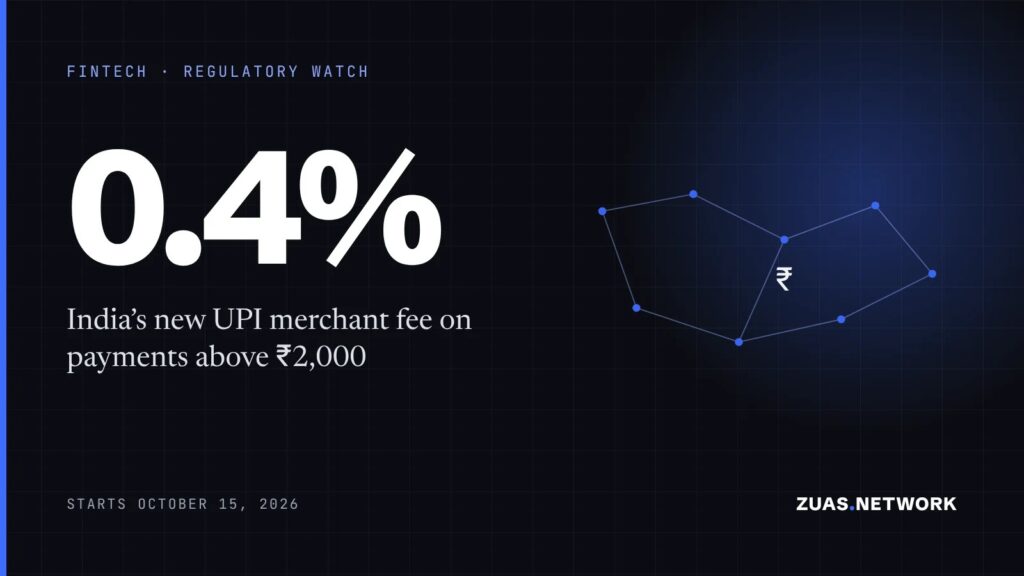
India will start charging a merchant fee on larger UPI payments on October 15, 2026, ending the zero-cost model that has applied to merchant transactions on the country’s real-time payments network since 2020. The change was first detailed in a September 15 FAQ from the Department of Financial Services, Forbes reported.
The move is notable because the Finance Ministry dismissed reports of a UPI merchant charge as “completely false, baseless, and misleading” in June 2025.
Key facts
- Start date: October 15, 2026
- Main rate: 0.4% on merchant payments above ₹2,000, capped at ₹300
- Still free: merchant payments up to ₹2,000, all person-to-person transfers, AutoPay mandates
- Exempt: small merchants receiving up to ₹1 lakh a month
- Rule: merchants may not pass the fee on to customers
Who pays and how much
Under the framework set by the UPI steering committee chaired by NPCI, merchants will pay a 0.4% merchant discount rate on payments above ₹2,000, with a ₹300 cap for payments of ₹75,000 or more. Payments for railways, telecom, insurance, fuel and utilities carry a flat ₹5 charge, and mutual fund and securities purchases are charged 0.02%.
According to the government’s estimate cited by Forbes, about 96% of merchant transactions will be unaffected. The catch is value: analysts at JM Financial and Jefferies estimate that payments above ₹2,000 make up roughly two-thirds of merchant payment value.
Why India is changing course
Banks and payment apps have long argued that free UPI is not sustainable. The government’s incentive budget has covered only a fraction of industry costs, and RBI Governor Sanjay Malhotra said in August 2025 that UPI “is not free even now, someone is paying for it.” The RBI has described the new fee as a step toward the long-term sustainability of India’s digital payments system.
Brokerage estimates cited by Forbes put the new annual revenue pool at roughly ₹15,000 crore to ₹20,600 crore, to be shared among issuing banks, acquiring banks and payment apps.
What it means for apps and merchants
The biggest beneficiaries are likely to be the dominant apps. PhonePe and Google Pay together handled about 78% of UPI volume in August, with Paytm at about 8%. Retailers’ groups, however, warn that fees could push some customers back to cash, and opposition politicians have called the charge a “UPI tax”.
A public interest petition challenging the change is pending before the Supreme Court. ZUAS will update this story if the rollout changes.
Sources
- Forbes (Zennon Kapron, contributor) September 27, 2026
